There are two main ways to get a postcard into local mailboxes. You can mail every home in a neighborhood, or you can mail only the specific people you pick.
The first is called EDDM. The second is a targeted mailing list. Neither one is “better.” They’re built for different jobs, and picking the wrong one is one of the easiest ways to waste a mailing. Here’s how EDDM vs. targeted mailing actually compares, in plain English.
What EDDM is
EDDM stands for Every Door Direct Mail. It’s a USPS service that delivers your piece to every address on the mail carrier routes you choose.
A few things make it different:
- No mailing list. You pick routes on a map, not names. Each piece is addressed to “Postal Customer.”
- Bigger pieces. EDDM is for “flats,” so your piece has to be larger than a standard postcard. USPS requires it to be more than 10.5 inches long, or more than 6.125 inches tall, or more than a quarter inch thick, and no heavier than 3.3 ounces.
- Route-level choices. The USPS EDDM tool lets you look at routes by Census averages like age, household income and household size. Those are averages for the whole route, not facts about each home.
- Volume rules. If you drop it off at the Post Office yourself (EDDM Retail), USPS sets a minimum of 200 pieces and a maximum of 5,000 pieces per day per ZIP Code.
In short: EDDM is the “cover the whole neighborhood” option.
What a targeted mailing is
A targeted mailing goes only to the addresses on a list. Every piece has a name or address printed on it.
That list can come from a few places:
- Your own customers. Past clients, current clients, people who asked for a quote.
- A list built by criteria. For example, homeowners in certain ZIP Codes, recent movers, or homes in a certain value range.
Because you’re paying to reach specific people, you can skip the homes that would never be a fit. You also have more freedom on size, so a standard postcard works.
The tradeoff: a good list costs money and takes a little setup. You’re paying for the list and the addressing, not just the printing and postage.
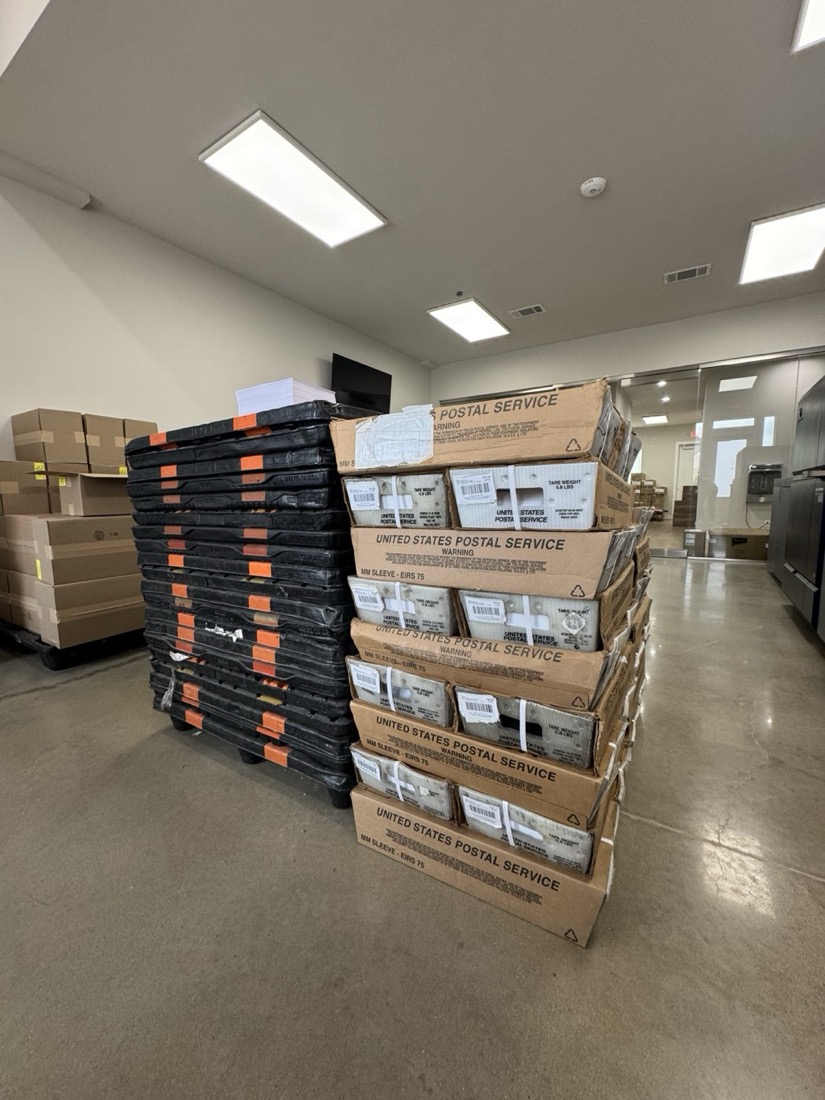 Trays packed and ready for the post office at our Prosper shop.
When EDDM makes sense
EDDM tends to fit when almost any household in the area could be your customer.
- Home services that every house needs sooner or later: pest control, lawn care, HVAC, pressure washing.
- Local spots that want the whole neighborhood to know they exist: a new restaurant, a dentist, a salon.
- You just finished a job and want every home on that street to see your name.
- You don’t have a list yet and want to get in front of a lot of local homes without building one.
The catch is honesty about waste. EDDM goes to every address on the route, including renters if you sell to owners and people who just bought from someone else. When most of the route is a fit, that’s fine. When only a slice of it is, you’re paying postage to reach people who will never call.
When a targeted list makes sense
A targeted list tends to fit when only certain households are a real fit.
- Your customer has a clear profile. Homeowners only, homes over a certain age, a certain income range, people who just moved in.
- You’re mailing your own customers. Renewals, check-ins, “it’s been a year since your last service.” Nobody should pay to mail the whole neighborhood to reach people already on their books.
- Each customer is worth a lot. When one job is a big ticket, it’s worth spending more per piece to reach the right homes.
- You want to track results closely. Since you know exactly who got the piece, it’s easier to match calls and sales back to the mailing.
A quick way to decide
Ask yourself one question: “Out of 100 homes on a typical street in my area, how many could actually become my customer?”
- Most of them? Start with EDDM. You reach everyone without paying for a list.
- Only a handful? Use a targeted list. You’ll mail fewer pieces, and more of them will land with people who can say yes.
- Not sure? That’s normal. Test a smaller run of one, track the calls, and adjust.
Here’s an illustration, not a quote. Say a roofer only works on homes 10 years or older, and half the homes in a neighborhood are newer than that. With EDDM, half the mailing goes to homes that can’t use the service yet. With a targeted list of older homes, every piece goes to a possible customer. The list costs more per piece, but the roofer may end up spending less overall to reach the same number of real prospects.
Whichever way you go, the bigger factors are still the same: a piece people actually want to read, a clear reason to call, and more than one mailing. One postcard rarely does the whole job.
The bottom line
EDDM covers everyone. A targeted list covers the right ones. Pick the one that matches who your customer really is, not the one that sounds cheaper per piece.
Not sure which fits? Our Run the Numbers tool helps you see what a mailing needs to bring in to pay for itself. Or tell us what you’re trying to do and we’ll help you pick the right approach, then handle the design, printing and mailing.